


8 Things That Make A Restaurant Bathroom Stand Out
- Salted Chair Hospitality

- Apr 16
- 5 min read
Updated: May 7
You know when you walk into a restaurant bathroom and pull out your phone? Not to check something. To photograph it.
That happens more than most people realise. And it matters more than most operators think.
A bathroom is rarely the reason someone books a reservation. But it can absolutely be the reason they talk about the place afterwards. It's one of the few moments in the guest experience that's completely personal, a brief pause from the table, the noise, the group. Just the guest and the space. What that space says in those few seconds reveals a lot about how much a venue truly cares.
And it all starts the moment the door opens.
BOLD WALLPAPER OR STATEMENT WALL FINISHES
The Walls Are The First Thing A Guest Sees.
In a space this small, walls do more than decorate. They set the entire mood within seconds.
Walk into a bathroom with plain white walls, and you walk straight back out having felt nothing. Walk into one with floor-to-ceiling botanical wallpaper, hand-painted tiles, or a richly layered texture, and suddenly you're reaching for your phone. The space stops being functional and starts being an experience.
The best bathrooms feel like a continuation of the restaurant's identity. Not a separate room, but another chapter of the same story. A strong wall treatment anchors that chapter. It doesn't have to be loud. It just has to be intentional.

And once the walls set the tone, everything else in the room gets to respond to it.
STATEMENT SINKS AND UNIQUE FIXTURES
A sink is not just a sink.
When the walls have already made a statement, the fixtures need to hold their own.
A sink is not just a sink. In a thoughtfully designed bathroom, the basin becomes a focal point. A sculptural vessel, an unexpected material, an unusually shaped form that signals someone made deliberate choices in here. The same goes for taps, towel rails, and hardware. Fixtures that feel considered, whether they lean into an industrial aesthetic, a soft organic shape, or something overtly luxurious, quietly elevate the entire room.
Guests may not be able to name what's different. But they'll feel it. And that feeling builds on what the walls have already begun: a sense that this space was designed, not just decorated.



From here, lighting decides whether that design actually comes alive.
THOUGHTFUL LIGHTING DESIGN
Lighting can make or ruin a bathroom, and most get it wrong.
Harsh overhead fluorescents are unforgiving. They flatten the space, drain warmth from it, and undo everything the walls and fixtures have worked to create. A well-lit bathroom, one with soft, warm light, a well-placed sconce, or a carefully chosen pendant, does the opposite. It flatters. It calms. It makes the space feel like somewhere worth being.
The lighting in a bathroom should feel as deliberate as the lighting in the dining room. Because in a restaurant where ambience matters, the mood shouldn't stop at the bathroom door. It should carry through, uninterrupted, as part of the same narrative.


And when the light is warm and beautiful, it does something else too: it makes the mirror worth looking at.
STATEMENT MIRRORS OR FOCAL POINTS
A Mirror Is Always Going To Be Part Of The Picture.
A mirror is always going to be part of the picture. The question is whether it's forgettable or whether it earns its place on the wall.
Oversized frames, arched shapes, antique finishes, hand-etched glass. A well-chosen mirror transforms the feel of an entire bathroom. It draws the eye, adds depth, and creates a natural moment for guests to pause. In a small space, it does the heavy lifting that a piece of art might do in a larger room.
Other focal points work just as well. A tiled niche, an original artwork, an unexpected decorative object. The goal is to give guests something to look at beyond their own reflection, something that makes the space feel curated rather than assembled.


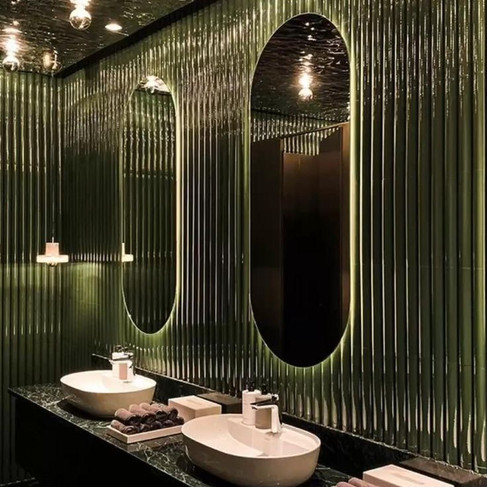
Yet even the most beautiful space falls apart the moment it doesn’t feel clean.
ATTENTION TO SCENT AND CLEANLINESS
5. This one isn't about aesthetics. It's about standards.
This one isn't about aesthetics. It's about standards.
No amount of beautiful wallpaper or sculptural sinks can recover from a bathroom that doesn't feel clean. Scent is immediate and visceral. Guests form a judgment within seconds of walking in, and that judgment reflects directly on the kitchen, the team, and the entire operation. A bathroom that smells fresh signals that the venue takes hygiene seriously everywhere.
But cleanliness is the baseline. Scent can be the signature. A carefully chosen diffuser, a subtle fragrance that echoes the mood of the space, these things add another sensory layer to the atmosphere. Some restaurants carry their scent all the way through, from entrance to bathroom, creating a thread of consistency that guests may never consciously notice but absolutely feel.

When a space smells purposeful, the materials it's built from feel like they were chosen with the same care.
HIGH-QUALITY MATERIALS AND FINISHES
High-Quality Materials and Finishes
Materials communicate value before a single word is spoken.
Stone countertops, marble surfaces, solid wood panelling, textured cement tiles. When guests see or touch these things, they register quality instinctively. It doesn't have to be expensive to feel right. But it does have to feel deliberate. Materials that look cheap, or that simply don't fit the concept, quietly undermine everything the rest of the restaurant has worked to build.
The bathroom is a small space, which actually makes it easier to invest in quality. A marble shelf. A terrazzo floor. A single panel of handmade tile. In a compact room, a little goes a long way.

Get the materials right, and even the smallest finishing touch starts to feel like it belongs.
SMALL LUXURY TOUCHES
The details guests didn't expect are the ones they remember longest.
A beautiful hand soap in a well-designed dispenser. A small ceramic tray holding a few simple accessories. A fresh flower in a narrow-necked vase. Real hand towels, or paper alternatives that feel surprisingly good. These things cost very little relative to the impression they leave. They tell guests that someone thought about their comfort even here, in a room most operators treat as an afterthought.
It's not about spending more. It's about caring more. And guests always notice the difference.

There's just one practical detail that almost nobody thinks to include. And it's the one guests feel most immediately when it's missing.
SPACE FOR COATS & BAGS
Ask any guest who has ever balanced a handbag on a wet sink edge or draped a coat over a cubicle door, and you'll understand immediately
A small hook. A coat rail. A ledge wide enough to actually rest something on. These are simple, inexpensive additions that make a significant difference to how comfortable and considered a space feels. In a venue where the guest experience is the priority, no moment should feel like an inconvenience, including this one.
And that, really, is the point of all of it.


Comments